Reassembling the Interchange
Turning a reconstructed ISA line and a pile of raw segments into one cleansed payload — and why doing the location work twice is free.
01 Refuse exactly when the ISA line does
This is the fourth act of the
x12-tidy method. The first three notes stop at one clean 105-byte
line. This one is about everything after it — the
GS/ST/SE/GE/IEA
segments that make up the rest of the interchange, and the one payload
they and the ISA line become.
clean_payload(dirty) is a total function over the same
input space as clean_isa_line, because it is built on top
of it:
- if the ISA line cannot be recovered,
clean_payloadrefuses — same diagnostics, no payload, nothing to split - otherwise it hands back one
ReconstructedPayload: the reconstructed ISA line, the body split into segments with the empty ones dropped, and everything rejoined on the sender's own terminator
Nothing new can go fatal here. Whether the body is well-formed — real identifiers, matched openers and closers, counts that add up — is not this step's question. This step's only job is mechanical: assemble one payload out of what the earlier steps already trust.
02 Two purely mechanical transforms
split_segments and drop_empty_segments
share one property, and the code says so directly:
no diagnostics, no validation, no refusal.
split_segments — src/x12_tidy/envelope/structure/segments.py
def split_segments(dirty: bytes) -> list[bytes]:
    located = extract_isa_line(dirty)
    if located.isa_line is None:
        return []
    decomposition = split_isa_line(located.isa_line, base_offset=located.isa_start)
    terminator = decomposition.segment_terminator
    if not terminator:
        return []
    contents = dirty[located.isa_start + len(located.isa_line):]
    contents = contents.strip(_WHITESPACE + terminator)
    return [piece.lstrip(_WHITESPACE) for piece in contents.split(terminator)]
Take everything after the ISA line — which, by
the locating step's own
contract, ends immediately before GS. Strip whitespace
and the terminator from both ends, so a trailing blank line or
a doubled closing terminator does not leave a spurious empty piece at
the end. Split on the segment terminator. Left-trim each piece — a
segment identifier is alphabetic and first, so leading whitespace is never
segment content.
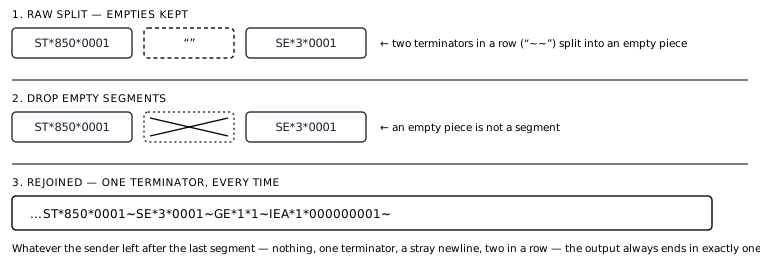
That produces the raw segments, empties included: two
terminators in a row (~~) split into an empty string
between them, and an empty string is not a segment.
drop_empty_segments
def drop_empty_segments(segments: list[bytes]) -> list[bytes]:
    return [segment for segment in segments if segment]
Neither function asks why the terminators were doubled, or
whether a identifier is real, or whether GS opens and
GE closes in the right order. Judging requires
context this step deliberately does not have. That is
the next note's job, once there
is a whole payload to judge.
03 The redundant parse, and why it costs nothing
Look again at split_segments: it calls
extract_isa_line and split_isa_line itself.
But clean_payload already called the full pipeline —
clean_isa_line, which runs those same two functions
internally, plus reconstruction — to get the repaired ISA line in
the first place.
clean_payload — src/x12_tidy/envelope/structure/payload.py
def clean_payload(dirty: bytes) -> ReconstructedPayload:
    isa_result = clean_isa_line(dirty)
    if isa_result.isa_line is None:
        return ReconstructedPayload(None, isa_result, (), list(isa_result.diagnostics))

    segments = tuple(drop_empty_segments(split_segments(dirty)))
    terminator = isa_result.segment_terminator
    body = b"".join(segment + terminator for segment in segments)
    payload = isa_result.isa_line + terminator + body

    return ReconstructedPayload(payload, isa_result, segments, list(isa_result.diagnostics))
So the ISA line gets located and its delimiters decomposed
twice — once by clean_isa_line, once
again by split_segments. That looks like waste. It isn't,
for two reasons.
It's pure and cheap. Locating and decomposing do no I/O, allocate nothing large, and run once per call regardless of file size beyond the initial scan. Paying for it twice on a single interchange is not a cost anyone will notice.
It's the price of keeping split_segments
honest. If split_segments instead took the
already-computed decomposition as an argument, it would stop being a
pure function of dirty alone — every caller would
have to thread the right upstream result through, and a mismatched pair
(segments split with one decomposition, an ISA line reconstructed from
another) becomes a class of bug that can exist. Recomputing from
dirty each time makes that bug impossible, not
just unlikely.
\n terminator stays
\n. So isa_result.segment_terminator, computed
via the reconstructed line, and the terminator split_segments
recovers independently from the same bytes, are always the same byte.
The body is split on it and rejoined on it without the two calls ever
having to be reconciled.
04 Reassembly always ends in exactly one terminator
Whatever the sender put after the last real segment — nothing,
one terminator, a terminator plus a stray newline, two terminators in a
row — the strip in split_segments removes all of it
from the end, and the join in clean_payload puts back
exactly one terminator after every segment, including the last. The
output always ends the same way, regardless of how the input did.
This is not a repair in the sense the ISA-line phase uses the word — there is no diagnostic for it, because nothing about it was wrong. A trailing terminator is not preserved information; it is punctuation the join regenerates. There is nothing to flag, so nothing is flagged.
05 The closed set of outcomes
| input | outcome |
|---|---|
| ISA line cannot be recovered | refused — no payload, no segments, the ISA-phase diagnostics say why |
| clean input | payload == dirty, byte-identical — was_clean |
| a right-trimmed ISA element | the reconstructed line anchors the payload, not the dirty one — the repair carries all the way through |
two terminators in a row (~~) |
the empty piece is dropped; not present in .segments |
non-~ terminator (\n, bare \r) |
preserved through the whole payload, not just the ISA line |
| trailing junk after the last segment | stripped; the reassembled payload ends in exactly one terminator |
Every row that isn't a refusal produces exactly one payload. There is still no third outcome.
06 Where validation takes over
ReconstructedPayload.segments is the raw body:
whatever identifiers and elements the sender sent, empties dropped, nothing
else touched. It has not been asked whether beg is a real
identifier, whether GS/GE and ST/SE
nest correctly, whether SE01 counts the segments it claims
to, or whether ISA13 matches IEA02.
Auditing the Envelope is where
all of that lives — the first place x12-tidy checks not just the
shape of a segment, but whether the interchange's own
bookkeeping is honest.
07 Proving it
The corpus for this step is the payload built from every case the
ISA-line notes already prove, plus a family of body-only deviations
layered on top of a known-good ISA line: a doubled terminator mid-body,
a non-~ terminator carried all the way through, and a dirty
ISA element whose repair has to survive the join. Each is checked
against the same shape of invariant the earlier notes use:
the assembly invariant
result = clean_payload(dirty)
if result.payload is None:
    assert result.diagnostics        # a refusal must say why
else:
    assert b"" not in result.segments                    # no empty pieces
    assert result.payload.startswith(result.isa_result.isa_line)
    assert result.payload == (
        result.isa_result.isa_line + terminator
        + terminator.join(result.segments) + terminator
    )
That last assertion is the whole claim in one line: the payload is exactly the reconstructed ISA line, the terminator, the cleaned segments joined on that same terminator, and one final terminator — never the dirty bytes, never a stray empty piece, never a different terminator than the one the sender chose.